
Business Outcomes, Not Features: The MaxxLogix Philosophy
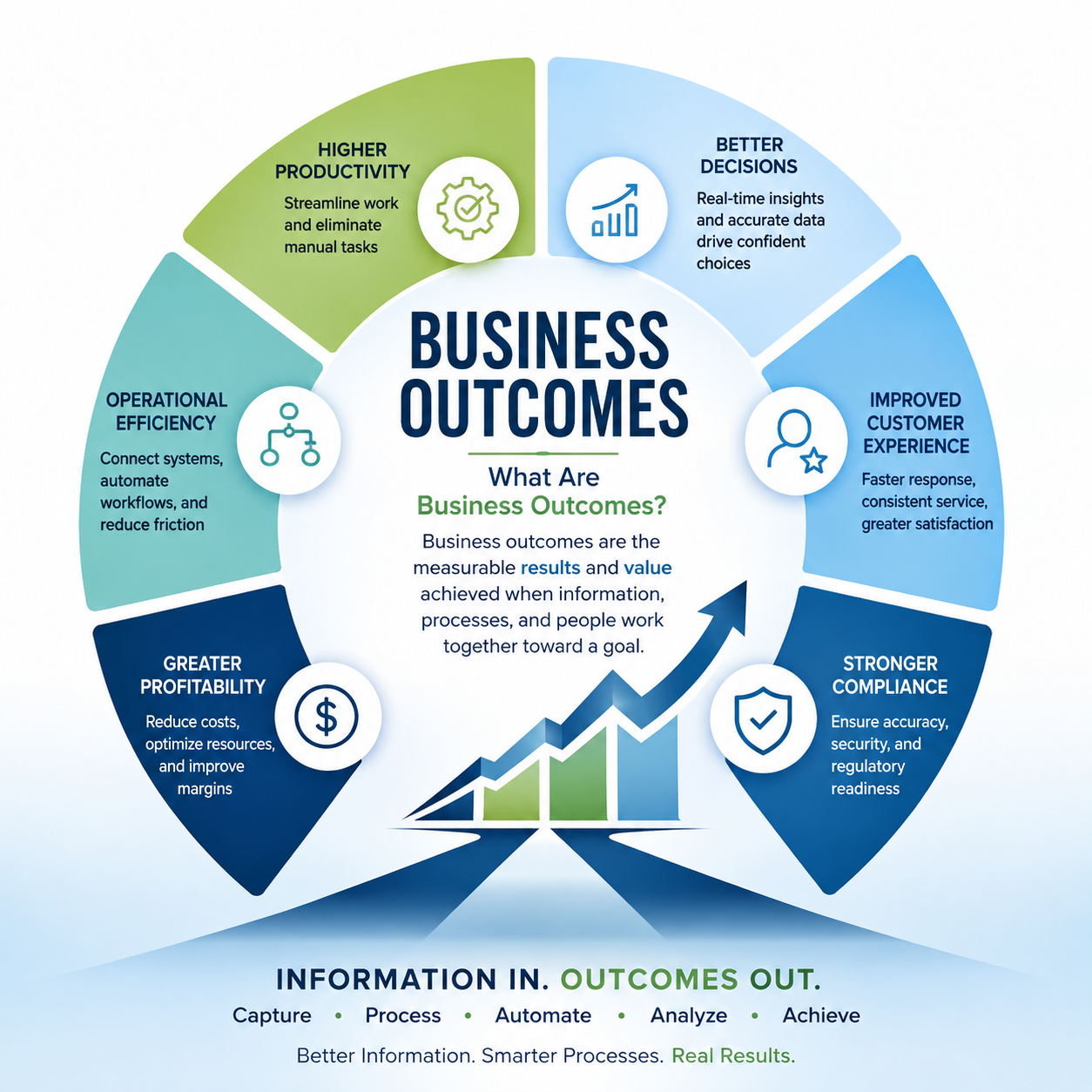
The Problem With Selling Software Features
Most enterprise software vendors lead with features. They’ll show you dashboards, workflow builders, and integration catalogs. They’ll demo drag-and-drop interfaces and tout API flexibility. But features are not results — and results are what your organization actually needs to justify investment, satisfy stakeholders, and move the business forward.
MaxxLogix takes a different position. When we talk about outcomes, we mean measurable, real-world results that matter to your business — not checkboxes on a procurement form.
What “Outcomes” Actually Means in Practice
An outcome is a change in business performance that can be observed, measured, and tied to a specific process improvement. It’s the difference between saying “we deployed an intelligent document processing system” and saying “we reduced invoice approval time by 67% and eliminated $340,000 in annual processing overhead.”
According to McKinsey & Company, organizations that focus their automation strategies on business outcomes — rather than technology deployment — are 1.5 times more likely to report successful digital transformation results compared to those that lead with tools. [1]
That distinction drives everything MaxxLogix does. When we engage with a new client, we don’t start by asking what software they want. We start by asking what is broken, what is slow, what is costing them money, and what is keeping them from scaling.
The Four Outcome Categories MaxxLogix Focuses On
MaxxLogix structures its engagement model around four core outcome categories that enterprise clients consistently care about:
1. Operational Efficiency
This is the most visible outcome. Intelligent document processing, automated routing, and AI-assisted data extraction remove manual steps that slow teams down. Gartner research shows that organizations using intelligent automation report an average 20–35% reduction in operational costs within the first 12 months of deployment. [2]
2. Compliance and Risk Reduction
For compliance officers, the outcome isn’t a feature — it’s a defensible audit trail, a consistent process, and a reduction in regulatory exposure. The cost of non-compliance is real: a 2023 Globalscape study found that the average cost of non-compliance events for enterprises reaches $14.82 million annually when factoring in fines, penalties, and remediation costs. [3] MaxxLogix’s workflow automation creates structured, documented processes that support compliance requirements across regulated industries.
3. Decision Velocity
When the right information reaches the right person at the right time — automatically — decisions happen faster. Faster decisions compound over time. According to research by Forrester, companies that invest in automation to improve information flow report a 3x improvement in decision-making speed compared to manual-process counterparts. [4] For enterprise managers, that speed translates directly to competitive advantage.
4. Employee and Customer Experience
Automation’s least-discussed outcome is what it frees people to do. When intelligent document processing handles routine data extraction, classification, and validation, your skilled team members shift to higher-value work. IBM Institute for Business Value reports that 72% of executives say automation has improved employee experience by removing repetitive, low-value tasks. [5] Better employee experience typically follows through to customer experience — and that matters at the bottom line.
Why Outcomes Require a Different Kind of Conversation
Outcome-focused engagements are more demanding than feature-focused ones. They require your team to be candid about where processes break down. They require agreement on what “better” actually looks like before any tool is deployed. And they require measurement — baselines, benchmarks, and post-implementation reviews.
That discipline is uncomfortable for organizations accustomed to judging technology by its feature list. But it is precisely that discipline that separates automation projects that produce genuine ROI from those that produce impressive demos and disappointing results.
MaxxLogix builds outcome definitions into every project kickoff. Before any workflow is designed, we establish the baseline state, define the target state, and agree on how success will be measured. That process ensures accountability on both sides.
Outcomes Are Not a Destination — They’re a Standard
One final point that shapes how MaxxLogix operates: outcomes are not a one-time achievement. A process that produces strong results in year one can drift, break, or become obsolete as the business evolves. Sustained outcomes require ongoing optimization — monitoring, exception handling, and adaptive refinement as volumes and requirements change.
This is why MaxxLogix positions itself not as a software vendor but as an automation partner. The goal isn’t to close a deal; it’s to produce results that your team can point to, your leadership can report on, and your organization can build on.
That is what outcomes mean at MaxxLogix.
Sources
[1] McKinsey & Company
[2] Gartner
[3] Globalscape / Ponemon Institute
[4] Forrester Research
[5] IBM Institute for Business Value