
Document Platform Security: Protection at Every Layer
When a platform holds your contracts, invoices, patient records, and personnel files, “is it secure?” is really several questions wearing one coat. Where does the data physically live? Who can reach it? What happens to it while it moves? And who has independently checked any of those answers?
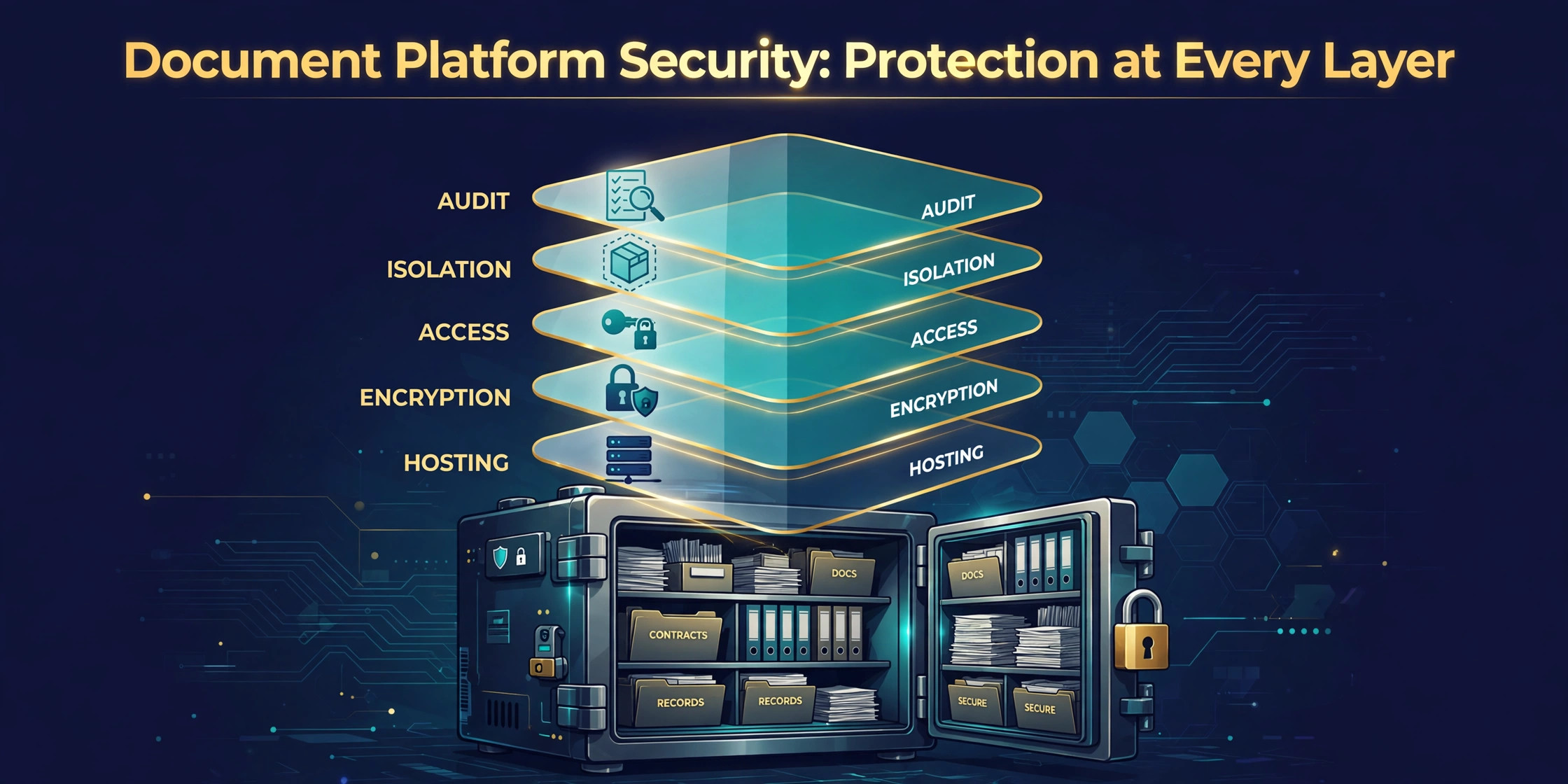
Document platform security is not a single feature. It is a stack of layers — infrastructure, encryption, access control, isolation, and audit — and each layer has an owner. This article walks the stack the way a security reviewer would, using the architecture of MaxxLogix® Outcome Cloud™ as the worked example. The full detail lives in our Security & Compliance Overview.
Layer one: where the data lives
Outcome Cloud™ runs only in Amazon Web Services regions in the United States — US East (N. Virginia) as the primary region, with backup and disaster recovery in US East (Ohio). Data for US customers is stored and processed only in the United States; there is no offshore processing.
That includes the AI. IDP Outcomes™ and MaxxOwl™ SI run through Amazon Bedrock inside MaxxLogix’s own AWS environment, so documents and data are processed within the same governed boundary as everything else — and for customers handling protected health information, no information is sent to public AI models at all.
Customers own all the information they store in Outcome Cloud™. MaxxLogix never claims ownership of it and never sells it.
Layer two: encryption, in transit and at rest
Every connection to the platform is encrypted with TLS 1.2 or higher, so documents and data are protected while they move between your people and the platform. Everything stored — including database tables — is encrypted at rest with AES-256.
Encryption is the layer reviewers ask about first because it is the layer that protects data even if another control fails. Data intercepted in transit is unreadable; data taken at rest is unreadable. Both directions are covered, all the time, not as an add-on.
Layer three: who can get in, and what they can touch
Access control in Outcome Cloud™ is role-based, with granular permissions that decide who can view, change, approve, and sign — down to the folder and function level. Multi-factor authentication and single sign-on are supported, alongside secure password policies, session management, and account lockout.
This is also where AI access is governed. Retrieval through MaxxOwl™ SI is permission-aware: the engine only returns what the person asking is authorized to see, a principle we explored in Permission-Aware Search. A powerful search tool that ignores permissions is a leak with a good interface; permission-aware retrieval is what makes enterprise search safe to deploy.
Layer four: tenant isolation
Each customer’s information is isolated from every other customer’s. Your documents and data are never pooled with another organization’s, and the isolation holds across storage, processing, and AI retrieval. For organizations handling sensitive information — including PHI for HIPAA-covered organizations, under a Business Associate Agreement chain that runs from your organization through MaxxLogix to AWS — isolation is what makes a shared cloud platform acceptable in the first place.
Layer five: proof, and an honest account of whose proof it is
Here is the layer where precision matters most, because it is the one most often blurred in vendor marketing.
Outcome Cloud™ runs only on AWS infrastructure. AWS’s infrastructure — data centers, hardware, network, and core cloud services — is audited under SOC 1, SOC 2, and SOC 3 by Ernst & Young, against the Trust Services Criteria for security, availability, confidentiality, and privacy.
MaxxLogix does not hold its own independent SOC 2 audit, and we say so plainly. What MaxxLogix provides is the application layer on top of that audited foundation: application security and tenant isolation, encryption, access control with MFA and SSO, the audit trail, backups and disaster recovery, incident response, and annual penetration testing.
That division is the honest way to evaluate any platform: audited infrastructure underneath, named application controls on top, and a shared-responsibility split you can read. Our overview spells out exactly which controls belong to your organization, your partner, MaxxLogix, and AWS — because no single party makes a deployment compliant on its own.
The operational layers reviewers forget to ask about
A few controls rarely make the brochure but always make the audit:
- Audit trail — every action is recorded: who did what, and when
- Backups — automated, with 14 days of restore points
- Disaster recovery — recovery to the Ohio region, with a target recovery point objective of 24 hours and recovery time objective of 48 hours after a regional outage
- Document retention — set to each customer’s own retention requirements, inside the Outcome Repository™
- Incident notice — customers are notified of a confirmed security incident affecting their data within 72 hours of discovery
- Secure development — design reviews, code reviews, controlled change management, security testing, and vulnerability management
How to use this in a vendor review
Turn the stack into questions, and insist on layer-specific answers. Where is data stored and processed — and does AI processing stay inside that same boundary? What encrypts data in transit, and what encrypts it at rest? Who can access what, and how is that access authenticated, reviewed, and revoked? How are tenants isolated, technically — not just contractually? What has been independently audited, whose controls did the audit cover, and who performed it? What happens after an incident: who is told, how quickly, and what do the recovery objectives promise?
Vague answers usually mean the layer is missing. A vendor that can name its regions, its encryption standards, its audit firms, and the boundary between audited infrastructure and its own application controls is describing a real architecture. A vendor that answers every layer with the same adjective is describing a brochure. Security review is not an obstacle to the purchase; done this way, it is the purchase’s quality control — the difference between a platform your compliance team can stand behind and one they will spend years working around.
Security is a stack, not a sticker
Document platform security holds when every layer does its job: US-only hosting on independently audited infrastructure, encryption in transit and at rest, granular permission-aware access, strict tenant isolation, and a complete audit trail — with each party’s responsibilities written down rather than implied. If your team is evaluating platforms, bring the layer-by-layer questions. Our Security & Compliance Overview answers them in full, and we are glad to complete your organization’s security questionnaire or walk your team through the controls.
Business Outcomes. Delivered.