
The Governed Platform: A Buyer’s Checklist for Security, Accessibility, and Audit-Ready Records
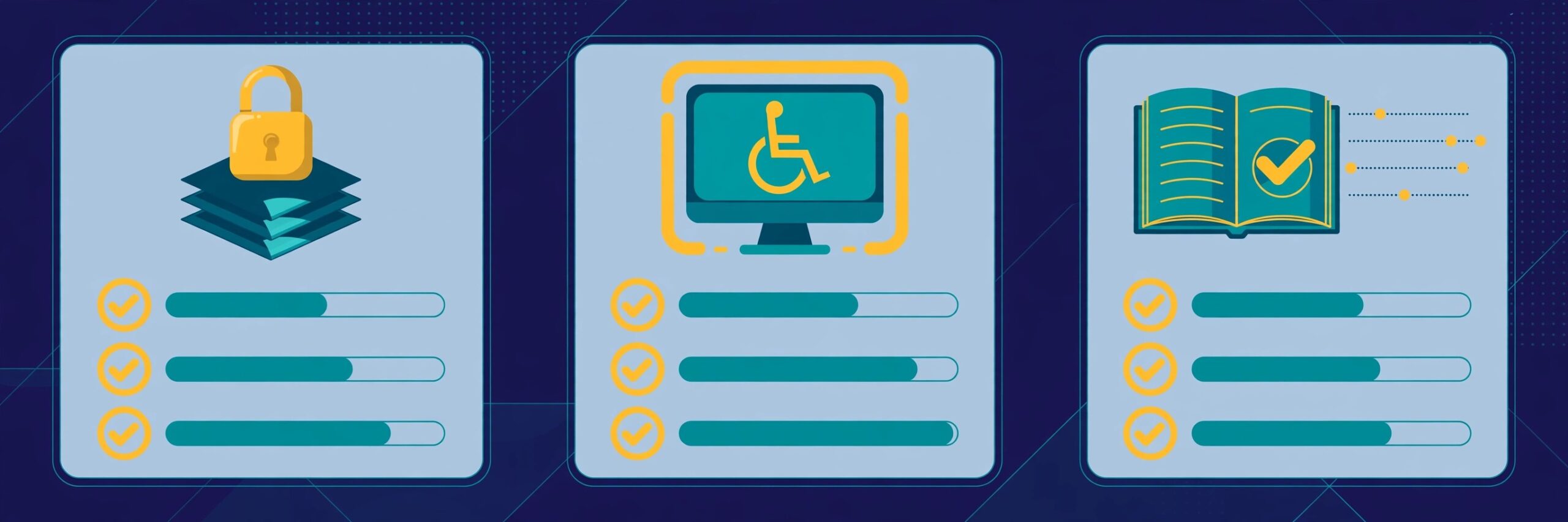
Platform purchases used to be decided on features and price, with governance invited in at the end to sign the paperwork. That order no longer survives contact with a real procurement. Security questionnaires arrive before the second demo. Accessibility conformance reports are requested in the RFP. Regulated buyers ask how records will stand up in an audit before they ask how the dashboard looks.
A compliant document management platform has to prove three things at once: it protects the information, it can be used by everyone who does the work, and it can show its history. The three proofs are usually evaluated by three different teams, on three different spreadsheets — which is how organizations end up with a platform that passes one review and quietly fails the other two. This checklist treats them as one evaluation, because in production they are one platform.
Part one: the security proof
Ask these of any platform that will hold your documents and data:
- Where is data stored and processed — which country, which regions, and is AI processing inside the same boundary?
- Is data encrypted in transit (TLS 1.2 or higher) and at rest (AES-256)?
- Is access role-based and granular, with multi-factor authentication and single sign-on supported?
- Are tenants strictly isolated, so your information is never pooled with another customer’s?
- Who owns the data — and is that written down?
- What has been independently audited, and precisely whose controls does the audit cover?
- What are the backup, disaster recovery, retention, and incident-notification terms?
On MaxxLogix® Outcome Cloud™, the answers are: United States only, on AWS; encryption in both directions; role-based, permission-aware access; strict tenant isolation; the customer owns its data, always. And on the audit question, the honest version: AWS infrastructure is audited under SOC 1, SOC 2, and SOC 3 by Ernst & Young, and MaxxLogix application controls — security, encryption, access control, audit trail, backups, incident response, annual penetration testing — sit on top. MaxxLogix does not hold its own independent SOC 2 audit, and any vendor conversation that blurs that line should make a buyer more careful, not less. The full answers are in our Security & Compliance Overview.
Part two: the accessibility proof
Accessibility fails in procurement when it is treated as a claim instead of a scope. Ask:
- Which standard, at which level — and which features were actually evaluated?
- How was it tested: automated scans only, or whole tasks by hand, with keyboard-only operation and named screen readers?
- Is there a current Accessibility Conformance Report (VPAT®-based) available on request?
- Are known gaps named, with a fix commitment — or is the answer a blanket assurance?
- What does the customer control that affects accessibility: form wording, themes, the documents they upload?
Outcome Cloud™ was evaluated against WCAG 2.1 Levels A and AA across its six core user features — login, search, document viewing, indexing, workflow tasks, and e-forms — tested task by task with a keyboard alone and with NVDA and Windows Narrator. One criterion, 1.4.10 Reflow, is partially supported, with a fix in progress, and the conformance report says so. Gaps treated as defects, fixes retested before release, documentation kept current: that is what a credible accessibility proof looks like. Full detail in our Accessibility Overview.
Part three: the audit-ready records proof
Whether your regulator is the FDA, an external auditor, or your own board, the question is the same: can you show what happened?
- Is there a complete audit trail — who did what, when, with old and new values — and is it read-only even to administrators?
- Can records be exported as one human-readable package, with signatures and audit trail attached?
- Are electronic signatures locked to their records, with re-authentication at signing?
- Does the workflow enforce step order, so approvals cannot happen out of sequence?
- Can the system be validated safely — test mode, release notes, advance notice of changes?
- Does the vendor state plainly what remains your responsibility?
Outcome Cloud™ was built to those questions: the 21 CFR Part 11 controls — audit trails, signature-record linking, operational and authority checks, validation support — are the same machinery that makes any record audit-ready, regulated or not. The vendor-assessment discipline behind this section is the one we applied in our IDP vendor evaluation guide: twelve questions that reveal whether a system finishes the job. Governance questions belong on the same list.
Scoring the three proofs together
A practical way to run the merged evaluation: score each proof on evidence, not impressions. For security, evidence means named regions, named standards, named auditors, and a written shared-responsibility split. For accessibility, evidence means a scoped conformance report, a described test method, and named gaps with fix commitments. For audit-ready records, evidence means a demonstrated audit trail — ask to see old and new values on a changed record, a signature locked to its record, and a complete export produced live, not described.
Then weight the failures correctly. A platform that is strong on security and records but weak on accessibility will fail the public-sector buyer at the deadline. A platform that is accessible and secure but cannot produce its history will fail the regulated buyer at the inspection. A platform that produces beautiful audit packages but pools tenant data will fail the security review it most needed to pass. The three proofs are a chain, and the purchase should be made — and priced — on the chain’s weakest link, because that is where the organization will feel it.
One more discipline ties the checklist together: get the answers in the vendor’s own documents, not in a sales conversation. Overview documents — the security overview, the accessibility overview, the compliance mapping — are where a vendor commits to specifics that can be quoted back in a contract, attached to a procurement file, and re-read at renewal. If a claim cannot survive being written down with its scope attached, it is not a control; it is a mood. Governed buying is mostly the habit of preferring the written, scoped, evidenced answer — and noticing which vendors reach for their documents and which reach for another adjective.
One platform, one evaluation
Security, accessibility, and audit-readiness are not three products. They are three properties of the platform your documents and data will live in — in the Outcome Repository™ and everywhere the work moves. Evaluate them together, demand scope and evidence instead of adjectives, and prefer the vendor whose overview documents name their limits as clearly as their strengths. Ours are gathered in one place: the MaxxLogix Resources library. Bring the checklist; we will walk it line by line.
Business Outcomes. Delivered.