
21 CFR Part 11 Electronic Signatures: What the Platform Must Support
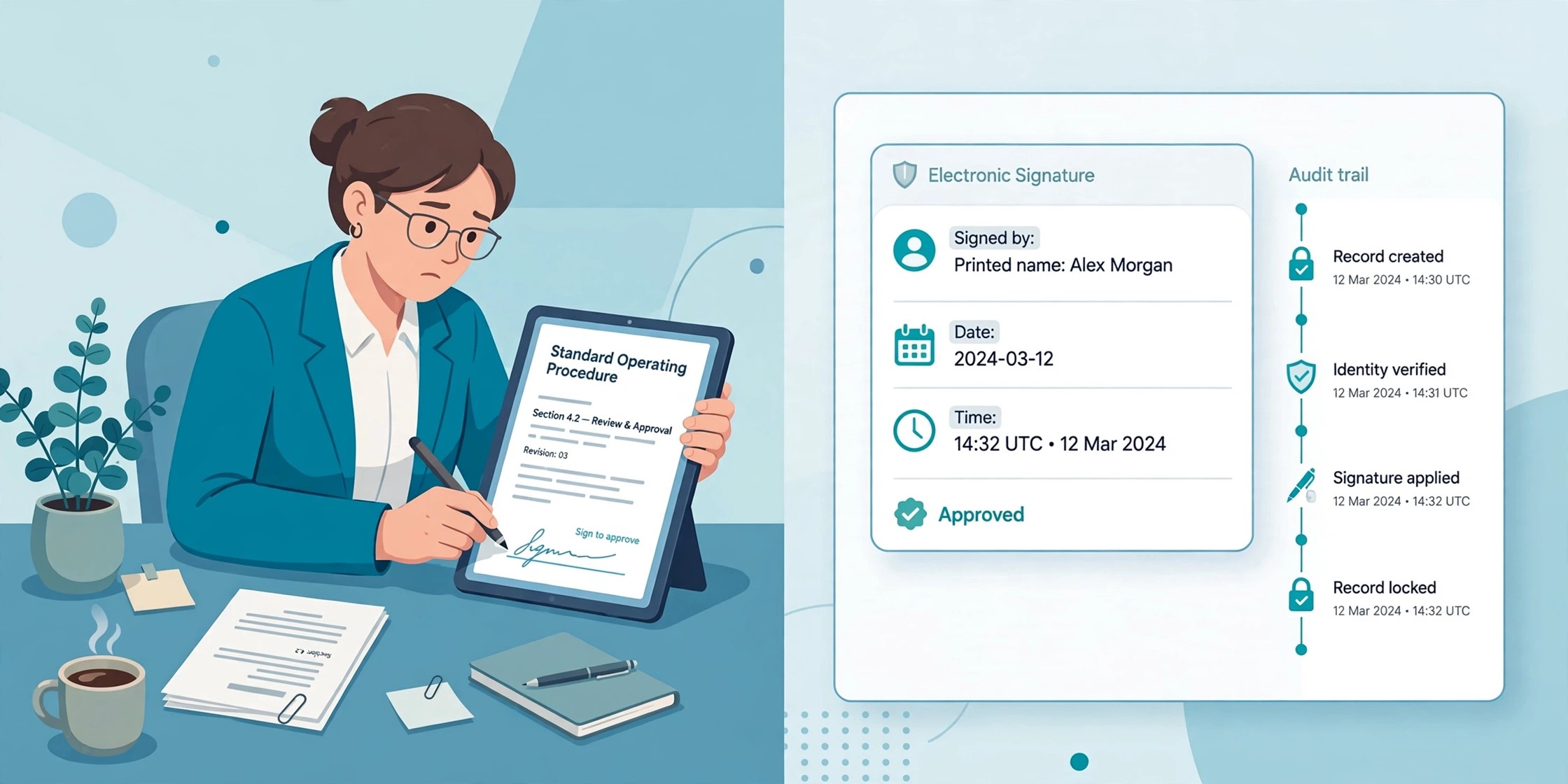
21 CFR Part 11 sets the conditions under which the FDA accepts electronic records and electronic signatures in place of paper. For life sciences, pharmaceutical, biotech, medical device, and clinical organizations, the regulation is not abstract — it decides whether an SOP approval, a deviation record, or a CAPA sign-off stored in a system will be trusted the way a signed paper page is trusted.
One clarification belongs at the front, because it shapes everything else: the FDA does not certify software. Compliance is something your organization achieves — by validating the system for its intended use and running the procedures around it. What a platform can do is provide the technical controls Part 11 requires, so your validation has something solid to stand on. This article maps those controls, section by section, to what MaxxLogix® Outcome Cloud™ provides. The full mapping is in our 21 CFR Part 11 Overview.
The record controls: §11.10 and §11.30
Part 11’s record requirements concentrate in §11.10, and they read like a checklist written by someone who has watched records go wrong:
- §11.10(a) — Validation. Workflows run in test mode, so your team can execute validation tests without affecting production records. You validate Outcome Cloud™ for your intended use; the platform gives you a safe place to do it.
- §11.10(b) — Accurate, complete copies. Records export as one human-readable package, such as PDF, with their signatures and audit trail attached.
- §11.10(c) — Protection and retention. AES-256 encryption at rest, retention set to your requirements, automated backups, and disaster recovery to a second US region.
- §11.10(d) — Limited access. Role-based security with granular permissions, multi-factor authentication, and single sign-on.
- §11.10(e) — The audit trail. Secure and time-stamped, recording the user, the date and time, and the old and new values of every change. Entries are read-only to everyone — including administrators — kept for the life of the record, and exportable.
- §11.10(f) — Operational checks. Outcome Workflows™ enforces the configured step order and blocks out-of-sequence actions, so a record cannot be signed before it has been reviewed if your process says review comes first.
- §11.10(g) — Authority checks. Role-based permissions control who can view, change, approve, and sign.
- §11.10(h) — Device and source checks. Access controls, configurable valid import channels, and URL whitelisting limit which sources can submit records.
- §11.10(k) — Documentation control. Release notes for every version, with advance notice of each release, so change never arrives unannounced in a validated environment.
- §11.30 — Open systems. TLS 1.2 or higher in transit and AES-256 at rest protect records moving through open systems.
The signature controls: §11.50 to §11.300
21 CFR Part 11 electronic signatures carry their own chain of requirements, and the chain is about one thing: a signature that can be believed, permanently attached to exactly what was signed.
- §11.50 — Signature manifestation. The signature block shows the signature, the signer’s full name, and the date and time, with a verification number. The meaning of the signature — approved, reviewed — is recorded in the audit log and workflow history, which print with the record.
- §11.70 — Signature-record linking. Each signature is locked to its record and cannot be copied or moved. Editing a signed record voids the signature or requires re-signing, so a signature can never quietly survive a change to what it approved.
- §11.100(a) — Unique signatures. Each user ID belongs to one person and is never reused or reassigned.
- §11.200(a) — Two-component signing. Signing is configurable: full credentials at every signing, or full credentials at the first signing in a session with the password for later ones — re-authentication at the moment of signing, either way.
- §11.300 — ID and password controls. Secure password policies, configurable password expiry, and account lockout, with suspicious login activity detected through AWS security monitoring.
Housed in the Outcome Repository™, the signed record, its signature manifestation, and its audit trail stay together as one evidence package — the same discipline regulated organizations apply to vendor requirements in other compliance regimes.
What this looks like on real records
Consider an SOP revision moving through quality review. The draft is versioned in the repository; reviewers’ comments and changes are recorded in the audit trail with old and new values; the approval step cannot be reached before review completes, because the workflow enforces the order. At signing, the approver re-authenticates, and the signature is manifested with name, date and time, and meaning — approved — then locked to that version of the record. If anyone edits the document afterward, the signature is voided or re-signing is required; the record can never quietly diverge from what was approved.
A deviation or CAPA follows the same rails: opened, investigated, reviewed, and signed, with every step’s actor and timestamp preserved and exportable as one package when an inspector asks. That is what “trusted records, trusted signatures” means operationally — not a feature toggle, but a chain of controls that holds from creation to inspection, years later, under questioning.
Validation support: helping you validate, and stay validated
Because your organization validates the system, the platform’s job includes making that work practical. Outcome Cloud™ provides test mode for running validation without touching production, detailed release notes for every version to support your impact assessment, and advance notice of releases so you can assess each one against your validated state before it lands. MaxxLogix can also support your IQ, OQ, and PQ activities as professional services.
And the shared-responsibility line stays visible: your organization validates the platform for its intended use, writes the SOPs for electronic records and signatures, trains users and keeps training records, verifies each user’s identity before issuing credentials, files the electronic signature certification with the FDA, and configures workflows, roles, and retention to match its regulated processes. The platform provides the controls; your procedures make them a compliant operation.
Trusted records, trusted signatures
Part 11 asks a simple question with demanding evidence: can this electronic record, and this electronic signature, be trusted the way paper is trusted? A platform supports the right answer with complete audit trails, signatures locked to their records, re-authentication at signing, encryption, and change control you can plan around. Our 21 CFR Part 11 Overview maps every control in full — bring it to your quality and compliance team’s vendor assessment.
Business Outcomes. Delivered.