
Bills of Lading, PODs, and Invoices: Logistics Documents That Close the Loop
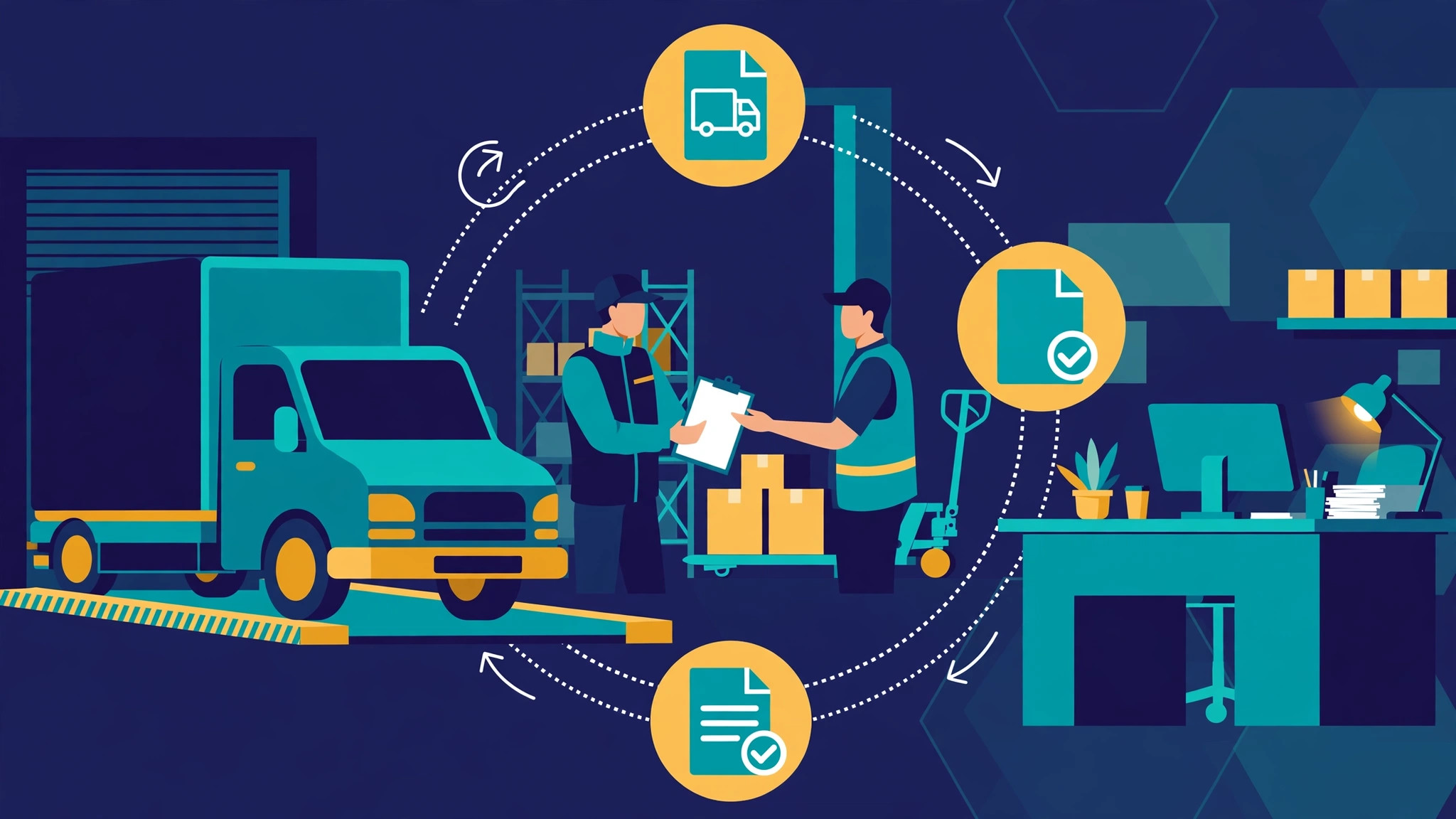
A truck pulls away from the dock on a Tuesday afternoon, and everyone at the warehouse considers the shipment done. The freight is gone. The dock is clear. But the shipment is not finished. It is finished days later, at a desk, when the bill of lading, the proof of delivery, and the freight invoice are all in hand and all agree. Until that moment, the work is open, the billing is waiting, and the revenue from a completed delivery is still sitting in paperwork.
That gap between the physical job and the paper job is where logistics operations quietly lose their time. The freight moved fine. The documents are what stall.
Logistics runs on matched documents
Every shipment generates a small set of documents, and each one makes a claim about what happened:
- The order says what was supposed to move, in what quantity, to where, and by when.
- The bill of lading says what was actually loaded and handed to the carrier.
- The proof of delivery says what arrived, in what condition, and who signed for it.
- The freight invoice says what the movement costs, including any charges beyond the base rate.
No single document tells the whole story. The story is in whether they agree. When the order, the bill of lading, the proof of delivery, and the invoice all line up, the shipment closes and billing proceeds on solid ground. When they disagree, someone has to find out why before anyone can confidently bill or pay.
Bill of lading processing, done well, is therefore not really about the bill of lading alone. It is about keeping the whole document set for a shipment together, readable, and compared, so agreement is verified rather than assumed.
Where the disagreements live
Most shipments match. The work concentrates in the ones that do not, and the disagreements tend to be specific. A short shipment means the proof of delivery records fewer units than the bill of lading says were loaded. A detention charge appears on the freight invoice that nothing in the shipment record explains. Damage noted on the proof of delivery at the moment of signing changes what the delivery is worth and who needs to know about it.
Each of these is resolvable, but only if it surfaces as a specific exception attached to a specific shipment. What stalls billing is the other version of the same problem: an invoice that does not get paid or sent because something, somewhere, does not look right, with the underlying documents spread across email, a carrier portal, and a filing system. The hunt for the paper takes longer than the resolution would.
Meanwhile, the open shipments accumulate. Billing waits on document sets that are almost complete. Questions from customers or carriers get answered from memory instead of from the record. The operation knows the freight arrived. It just cannot prove the details quickly enough to close the loop.
What a closed loop looks like
The outcome for a shipment is not any one of its documents. An outcome is what got done with it: a closed loop, where the shipment’s full document set is matched, any exception is identified precisely, and invoicing proceeds without a paper hunt. That outcome is the unit of work, and in Outcome Cloud™, work is counted in Outcomes, one completed unit at a time.
MaxxLogix is a documents-and-data platform, and Outcome Cloud™ runs this work end to end. IDP Outcomes™ reads and extracts the key information from each document as it arrives: shipment identifiers, quantities, dates, signatures, notations, and charges. The document set for each shipment assembles around the shipment itself, so the bill of lading, the proof of delivery, and the invoice are always looked at together, in context, rather than as unrelated files.
Matching against every governing document
Traditional matching in freight and accounts payable compares a fixed set of documents against each other. Logistics rarely stays that tidy. Depending on the shipment, the governing documents can include the order, the bill of lading, the proof of delivery, the freight invoice, a rate confirmation, and delivery documentation that carries notations made at the dock. The right comparison is against everything that governs the shipment, not a predetermined trio.
That is the role of N-Way Match™, a Platform Extension that extends matching beyond a fixed set. As the Series 1 article on moving from 3-way match to N-Way Match™ explains, matching validates each document against the governing documents for that transaction, however many there are, so quantities, amounts, and terms are checked against the full record rather than a partial one.
When the documents agree, the shipment closes and the path to invoicing is clear. When they do not, the exception names the disagreement: which document, which field, and what it was compared against. A short shipment is a quantity difference between the bill of lading and the proof of delivery. An unexplained charge is an invoice line with no support in the shipment’s documents. Each exception is specific enough for someone to resolve it, and Outcome Workflows™ routes the approvals and the follow-up work to the people who own them.
When the loop closes, Outcome Repository™ files the result: the matched document set and its resolution history, stored together as the shipment’s record. If a customer or carrier questions a charge months later, the answer is a retrieval, not a reconstruction.
The same pattern across the operation
Logistics is one of the 15 common areas where MaxxLogix applies this approach, and the pattern travels well because it is not specific to freight. Wherever work finishes only when a set of documents agrees, the discipline is the same: collect the full set, extract what each document says, match it against everything that governs it, and turn disagreements into specific, resolvable exceptions instead of open questions.
For logistics teams, the practical effect is a billing cycle that runs on verified document sets. Invoices go out supported by the bill of lading and the signed proof of delivery. Freight invoices get paid against what the shipment record supports. Exceptions get resolved while the details are still fresh, by people looking at the actual documents instead of searching for them.
Close the loop on every shipment
If your billing waits on document hunts and your exceptions arrive as vague questions instead of specific disagreements, the fix is a document set that assembles, matches, and closes for every shipment. Talk with MaxxLogix about your logistics documents, and visit the verticals hub to see how the same closed-loop approach applies across your operation.
Business Outcomes. Delivered.